
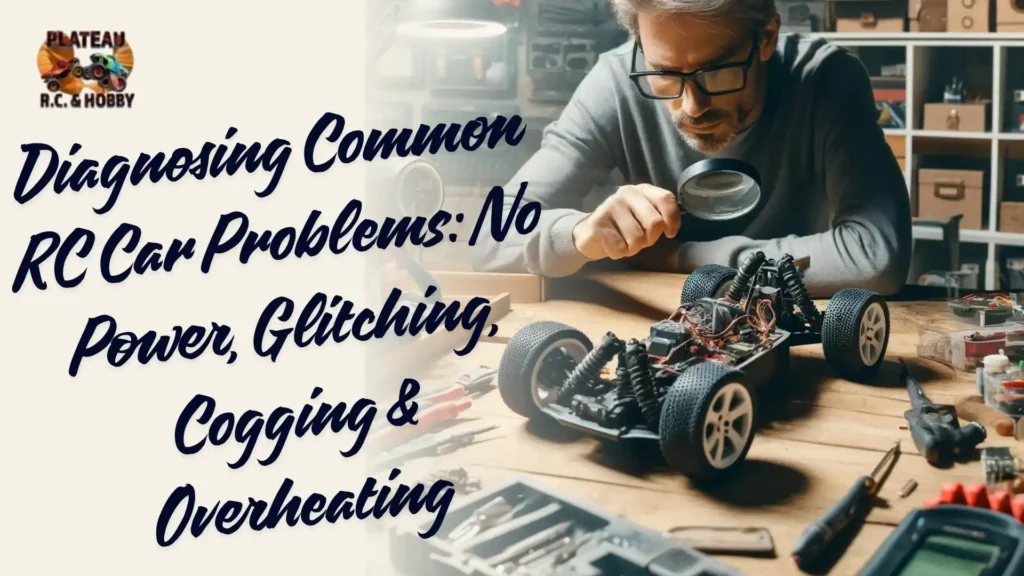
Few things are more annoying than charging your batteries, heading out to drive… and your RC car refuses to cooperate.
Maybe it won’t power on, maybe it jitters and glitches, maybe the motor cogs and stutters off the line, or everything overheats after a few minutes. The good news: most issues follow a few common patterns, and you can diagnose a lot of them yourself.
This guide walks you through step-by-step troubleshooting for four of the most common RC car problems:
- No power / won’t turn on
- Glitching, stuttering, or cutting out
- Cogging at low speed (especially brushless)
- Overheating (motor, ESC, or battery)
Use it like a checklist and go symptom by symptom.
Before You Start: Quick Safety Check
Before poking around your RC car, do a quick safety pass:
- • Use a safe surface – Work on a table, pit mat, or bench, not on grass or gravel.
- • Keep LiPos safe – If you suspect battery damage (swelling, puncture, weird smell), stop and handle it carefully.
- • Turn off the transmitter last – When you’re done testing, turn off the car first, then the radio, to avoid runaway issues.
Now let’s go problem by problem.
1. RC Car Has No Power (Won’t Turn On)
Symptom: You plug in the battery, flip the switch… nothing. No lights, no beeps, no steering.
Step 1: Check the obvious
- Battery actually charged?
- Put it on the charger and confirm it was fully charged (not just “plugged in”).
- For LiPo, check cell voltage if you have a checker.
- Correct battery plugged in?
- Sounds silly, but many of us have grabbed a dead pack by accident.
- Confirm the plug type & polarity are correct for your ESC.
Step 2: Inspect battery connectors & leads
- Wiggle the battery connector (Deans, EC3, XT60, etc.) and look for:
- Loose solder joints
- Melted plastic housings
- Bent or pushed-back pins
If the connector feels hot or looks burned, replace it before running the car again.
Step 3: Check the on/off switch and ESC power
- Make sure the ESC switch is actually in the ON position. Some are tiny and easy to bump.
- Look for any LED light on the ESC:
- No LED at all → ESC might not be getting power or is dead.
- Faint flicker → Bad connection or very low voltage.
Try:
- Unplug the battery.
- Check the ESC plug going into the receiver (usually CH2). Reseat it firmly.
- Plug the battery back in and switch it on again.
Step 4: Test the receiver & servo
If still dead:
- Plug a known-good servo into the receiver’s steering channel and see if it responds when you turn the wheel on the radio.
- If there’s no response at all, the receiver might not be getting power (BEC problem from ESC) or the receiver is dead.
Step 5: Look for pinched or broken wires
Follow the main wires:
- • Battery → ESC → Motor
- • ESC → Receiver
Look for:
- Cuts, pinch points under the chassis or body
- Exposed copper
- Wires pulled partially out of plugs
Any badly damaged wire should be repaired or replaced before running the car again.
If absolutely nothing powers up after all this, the ESC or receiver may have failed and may need replacement or professional diagnosis.
2. Car Powers On, But Won’t Move
Symptom: The RC powers up, steering might work, but the car won’t drive forward or backward.
Step 1: Check the transmitter
- Throttle trim – Make sure it’s centered.
- Throttle reverse – If it’s accidentally reversed, the ESC may think neutral is full throttle.
- Confirm the battery in the transmitter is not dying; weak TX batteries can cause weird issues.
Step 2: Confirm ESC is armed and calibrated
Many ESCs need to see a valid neutral signal before they will drive:
- Turn on the transmitter.
- Set throttle trim to neutral and throttle to zero.
- Turn on the car.
- Listen for the ESC beeps or watch LED patterns indicating it’s armed.
If it still doesn’t move:
• Perform a throttle calibration (check the ESC manual for steps; typically involves powering up with full throttle, then full brake, then neutral).
Step 3: Check drive components
If you hear the motor spinning but the car doesn’t move:
- Look at the pinion gear on the motor shaft – is it loose or missing?
- Check the spur gear – stripped teeth are common after a hard crash.
- Inspect drive shafts, axles, or dogbones – any broken piece will disconnect power to the wheels.
- Check if the slipper clutch is too loose (the spur gear hub spins without turning the wheels).
If the motor doesn’t spin at all:
- Make sure motor wires are firmly seated in the ESC.
- For brushless, check all three wires; if one is loose, it may just twitch.
- For brushed motors, look for disconnected or broken motor wires.
3. Glitching, Stuttering, or Random Cut-Outs
Symptom: The RC car starts and runs but randomly:
- Loses control for a moment
- Stutters at mid-throttle
- Briefly loses steering or throttle
- Cuts out under acceleration and then comes back
Step 1: Check radio link & interference
- Ensure transmitter and receiver are properly bound.
- Keep the transmitter antenna upright, not wrapped around the handle.
- Make sure the receiver antenna on the car isn’t:
- Cut short
- Buried under carbon fiber or metal
- Bunched up right next to motor/ESC wires
If you recently changed radio gear or mounted electronics differently, try re-routing antenna and signal wires away from motor wires.
Step 2: Power brownouts (BEC or battery sag)
Glitches can happen when the receiver briefly loses power:
- Weak or nearly empty battery
- Too much load on the ESC’s BEC (for example, a power-hungry steering servo)
- Old or cheap connectors causing voltage drops under load
Try this:
- Use a fresh, fully charged battery with good C rating.
- Check that the servo isn’t binding or overloaded (turn the wheels lock-to-lock by hand).
- If you have multiple high-power servos or lights, consider a separate BEC.
Step 3: Loose connectors
Glitching while bouncing around off-road is often just:
- A loose plug at the receiver
- A partially seated motor or battery connector
Push every plug in firmly and consider a small piece of tape or a clip over loose-fitting plugs.
4. Cogging at Low Speed (Brushless Cars)
Symptom: You gently pull the trigger and the car jerks, stutters, or “cogs” instead of rolling smoothly. Once it’s moving, it may run fine.
Cogging is common with sensorless brushless motors, especially with:
- Tall gearing
- Heavy cars
- Underpowered batteries
Step 1: Check gearing
- If you recently installed a larger pinion gear for more top speed, you may have pushed too far.
- Try dropping 2–3 teeth on the pinion and test again. Shorter gearing = easier start-up torque.
Step 2: Battery capability
- Under-rated or old LiPos can’t supply enough current for strong low-speed torque.
- Use a pack with sufficient C rating and capacity for your motor/ESC combo.
- Try a different battery and see if cogging improves.
Step 3: Sensor wire (for sensored systems)
If you’re running a sensored brushless system:
- Make sure the sensor wire is fully plugged in at both motor and ESC.
- Inspect it for cuts or pinches.
If a sensored system loses its sensor signal, it may behave like a sensorless one and cog more at low speeds.
Step 4: ESC settings
Some ESCs allow tuning of:
- Start-up power / punch
- Timing
- Motor type
If the start-up power is too low, the car may struggle to get going smoothly. If timing is cranked too high, you may get heat and cogging. Resetting the ESC to a known “stock” profile and re-testing is often a good move.
5. Overheating Motor, ESC, or Battery
Symptom: After a few minutes:
- Motor is too hot to touch for more than a second or two
- ESC feels extremely hot, or thermal protection kicks in
- Battery is very warm or puffing (LiPo danger sign)
Step 1: Check gearing & surface
Overheating is usually caused by too much load:
- Gearing too tall (big pinion, small spur)
- Running in thick grass, deep carpet, sand, or high-drag surfaces
- Heavy wheels/tires that are larger than stock
Fixes:
- Drop pinion size by 2–3 teeth and retest.
- Avoid long full-throttle runs on high-drag surfaces.
- Use appropriate tire sizes for your motor/ESC combo.
Step 2: Check drivetrain for binding
- Spin the wheels by hand with the car off. They should roll freely.
- Look for:
- Bent drive shafts
- Tight wheel bearings
- Debris stuck in gears or around axles
Binding = extra load = extra heat.
Step 3: Airflow and mounting
- Ensure the ESC and motor are getting some airflow, not completely boxed in.
- Remove grass, dust bunnies, and gunk blocking vents.
- Consider small cooling fans for motor/ESC if the system is right on the edge.
Step 4: Battery health
If your LiPo is:
- Getting unusually hot,
- Losing punch quickly, or
- Starting to puff,
Stop using it and replace it. A damaged LiPo is both weak and dangerous.
6. When to Stop Immediately
Some symptoms are “finish the pack and fix later” level. Others mean: stop now.
Stop running the car if:
- You see smoke from motor, ESC, or battery
- You smell burning electronics
- The battery is swelling or leaking
- The ESC keeps hitting low-voltage cutoff very quickly
- The car makes loud grinding or screeching noises from the drivetrain
Continuing to run in these conditions can turn a small repair into a big one or create a fire hazard in the case of LiPos.
7. Preventive Tips to Avoid These Problems
A few simple habits will make all of this troubleshooting much less common:
- Use a maintenance checklist after every few runs (clean, inspect, tighten screws).
- Store LiPo batteries at storage voltage when not in use for a while.
- Check gearing and temps when you change wheels, surfaces, or motor/ESC combos.
- Keep motors, ESCs, and receivers clean and dry.
- Don’t ignore early warning signs—small glitches often become major failures if you keep pushing.

 ICONIER Digital Agency