
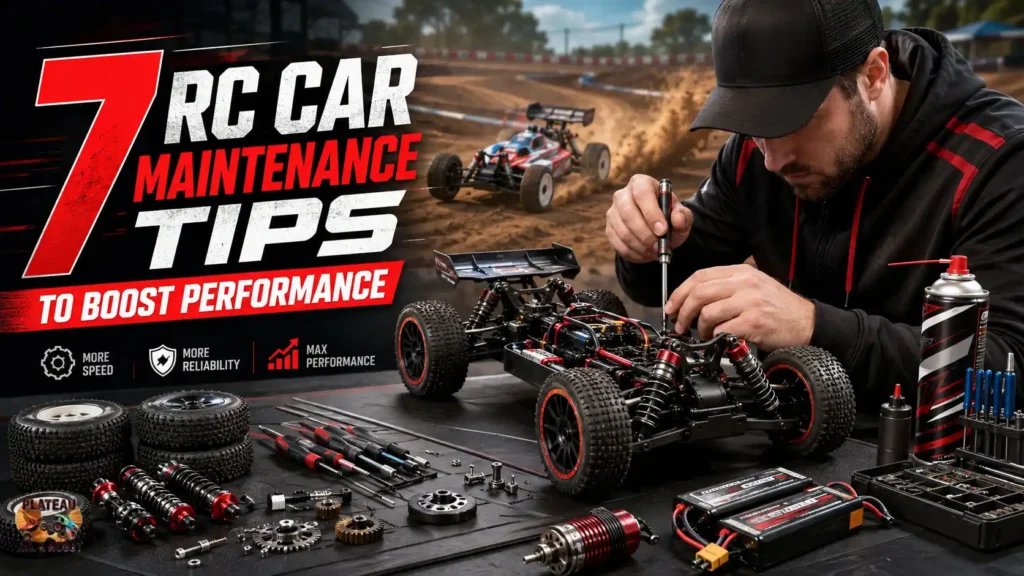
Have you noticed your RC car slowing down lately? Maybe the battery drains much faster than it used to, or you hear strange, grinding noises coming from the chassis when you accelerate.
Every beginner and intermediate driver faces these frustrating performance drops. The good news? The solution is usually just basic RC car maintenance.
Radio-controlled vehicles are precision machines. Taking care of your car doesn’t just keep it looking great it directly impacts its top speed, handling, and durability. Here at Plateau RC & Hobby, we know firsthand how proper upkeep transforms a sluggish buggy into a track-tearing beast.
Let’s dive into our top RC car maintenance tips to keep you racing at peak performance!
Why RC Car Maintenance Is Important
Whether you’re bashing in the backyard or racing at the local track, wear and tear is inevitable. Following a solid RC car care guide for beginners provides three massive benefits:
- Performance Improvement: Clean gears, properly meshed pinions, and fresh lubrication instantly improve RC car speed and performance.
- Cost Savings: Spotting a loose screw today prevents replacing a shattered suspension arm or stripped gear tomorrow.
- Longer Lifespan: Learning how to extend RC car lifespan means more time driving and less time waiting for replacement parts to arrive in the mail.
Tip #1 – Keep Your RC Car Clean After Every Run
Dirt, dust, and mud are the absolute biggest enemies of any radio-controlled vehicle. Leaving grime on your chassis leads to clogged gears, rusted bearings, and overheated electronics.
Make cleaning your RC car after use a non-negotiable habit. Grab a soft-bristled paint brush or an air compressor to blow away loose dust and debris.
Pay special attention to the wheels, suspension arms, and drivetrain. For stubborn mud, use a damp microfiber cloth or an RC-safe cleaner. Proper RC car cleaning and maintenance is the foundation of a reliably fast vehicle.
Tip #2 – Take Care of Your RC Car Battery
Your battery is the beating heart of your vehicle. Poor battery habits are the number one reason for sluggish speeds and embarrassingly short run times.
Proper RC car battery care starts with correct charging. Always use a high-quality balance charger for LiPo (Lithium Polymer) batteries, and never leave them charging unattended.
Avoid running your battery until it’s completely dead, as this permanently damages the delicate cells. When you’re done for the day, store your batteries at a “storage voltage” (usually around 3.8V per cell) safely in a fireproof LiPo bag.
Tip #3 – Inspect and Tighten Screws Regularly
RC cars experience intense vibrations, especially during high-speed off-road bashing. Over time, these heavy vibrations rattle screws loose, which can lead to catastrophic mid-run failures.
After every few runs, take a high-quality hex driver and check the essential screws. Focus primarily on the motor mount, steering linkages, suspension pivot points, and wheel nuts.
Be very careful not to overtighten them, as you can easily strip the plastic threads on the chassis. Applying a tiny dab of blue thread-locker on metal-to-metal screws is an excellent way to elevate your RC car parts maintenance routine.
Tip #4 – Maintain the Motor and Electronics
Your motor and electronic speed controller (ESC) work incredibly hard. If they overheat, your vehicle’s performance will drop dramatically, and you risk permanent electrical damage.
Effective RC motor maintenance involves keeping the motor completely free of dust, sand, and debris. If you run a brushed motor, periodically check the internal brushes for wear and tear.
For brushless motors, ensure the cooling fan is spinning freely and isn’t jammed with rocks. Routinely check all your wiring for any frayed edges or exposed copper, and secure loose wires with zip ties to keep them away from moving gears.
Tip #5 – Lubricate Moving Parts
Friction is the ultimate speed killer. If your wheel bearings and gears are bone-dry, your motor has to work twice as hard, draining your battery faster and reducing your top speed.
To how to maintain RC car performance, apply a single drop of high-quality RC bearing oil to your wheel bearings, axles, and drivetrain joints.
If you have exposed spur and pinion gears, clean them thoroughly, but avoid using sticky grease that attracts dirt. For sealed differentials, ensure they are topped up with the correct weight of silicone oil.
Tip #6 – Check Tires and Suspension
Your tires and suspension dictate how your motor’s power actually translates to the ground. Bald tires or leaking shock absorbers will make even the fastest, most expensive car handle poorly.
Inspect your tires for tears and ensure they are securely glued to the rims all the way around. If the treads are worn completely flat, it’s time to upgrade your grip with a fresh set of rubber.
Press down firmly on your car’s suspension. It should rebound smoothly and evenly. If it feels overly bouncy or sluggish, you likely need to refill the shock oil or replace bent shock shafts.
Tip #7 – Store Your RC Car Properly
How you store your vehicle is just as important as how you drive it. Tossing it in a damp garage or a hot car trunk is a guaranteed way to rust metal components and ruin electronics.
Always store your RC car in a dry, cool place out of direct sunlight. Direct UV rays can fade the body shell and make plastic parts incredibly brittle over time.
Elevate the car on a stand or take the wheels off entirely during long-term storage. This takes the weight off the suspension and prevents the tires from developing flat spots. Also, don’t forget to remove the AA batteries from your transmitter!
Quick RC Car Upkeep Checklist
Need a quick, actionable reference before you hit the track? Save this handy RC car upkeep checklist for your pit box:
- Blow off loose dirt, grass, and dust from the chassis.
- Check battery voltage for swelling or damaged cables.
- Tighten wheel nuts, steering linkages, and motor mount screws.
- Check gear mesh (the spacing between the pinion and spur gear).
- Apply a single drop of lightweight oil to wheel bearings.
- Inspect tires for unglued edges, tears, or flat spots.
- Test the radio system and steering servos before driving.
Common Maintenance Mistakes to Avoid
Even with the best intentions, it’s remarkably easy to make errors that hinder your vehicle’s capability. Here are a few essential RC car troubleshooting tips to keep you on the right path:
- Skipping the post-run clean: Leaving wet dirt on your car accelerates wear and rust exponentially.
- Ignoring battery care: Storing a fully charged or fully depleted LiPo ruins its capacity and lifespan.
- Over-lubrication: Dripping way too much oil attracts thick dirt, creating a destructive grinding paste that destroys gears.
Why Choose Plateau RC & Hobby?
Whether you are frantically searching for an “RC hobby shop near me” to fix a broken shock, or you just need expert advice on a new build, Plateau RC & Hobby is your ultimate destination.
We pride ourselves on offering industry-leading expertise, premium replacement parts, and top-tier maintenance tools for hobbyists of all levels.
From beginner diagnostics to advanced suspension tuning, the Plateau RC & Hobby RC services team is here to help you get the absolute most out of your vehicle. Explore high-quality RC car parts in our shop both locally and online and upgrade your RC car performance today!
Conclusion
Regular RC car maintenance is the ultimate secret to unlocking your vehicle’s true potential. By keeping the chassis clean, caring for your LiPo batteries, and staying on top of lubrication, you guarantee a faster, more reliable ride every time you pull the trigger.
Don’t let a lack of basic upkeep ruin your weekend bashing sessions. Implement these simple, beginner-friendly habits to see an immediate boost in how your car handles, jumps, and accelerates.
Keep your RC car running at peak performance with expert tips, premium upgrades, and trusted tools from Plateau RC & Hobby!
FAQs
You should perform basic RC car maintenance, like blowing off dirt and checking for loose screws, after every single run. A deeper clean and fluid check (shocks and differentials) should be done every 10 to 15 runs.
The best method is using an air compressor or soft brush to remove loose dirt first. Follow up with a damp microfiber cloth for stubborn grime. Never submerge your car in water unless the electronics are verified to be 100% waterproof.
You can dramatically improve performance by upgrading to a higher-capacity, higher-discharge LiPo battery, changing your gear ratios, ensuring all bearings are clean and lubricated, and upgrading to a brushless motor system.
With proper RC car battery care and balanced charging, a quality LiPo battery can last for 2 to 3 years or roughly 150 to 300 charge cycles before its performance and punch start to drop significantly.
Yes! Removing compacted dirt from the drivetrain and keeping the bearings lubricated drastically reduces rolling friction. This allows your motor to spin freely, directly increasing your acceleration and top speed.

 ICONIER Digital Agency